“If kids are old enough to be shot, they’re old enough to have an opinion about being shot.” – Trevor Noah
For as long as I can remember, my father has called the week before the collegiate fall semester begins “make nice week.” The days are filled with vacuous, perfunctory meetings to review policies and procedures. Team-building exercises follow, allowing faculty to smooth over any remaining ruffled feathers from the previous semester.
This year it was more of the same with one notable exception.
We spent one morning reviewing how to steel ourselves and shield our students from an active shooter.
There was fear and confusion showcased in the questions asked and hypothetical posited.
But the overwhelming response was resignation:
“This is how things are now.”
“This is just the reality of the situation.”
“There’s nothing to be done. We just have to be prepared and have a plan in place.”
Nothing to be done?
This insistence that we live in fear as we go to school, or a concert, or a club, or a church is damning. It breeds indifference and complacency.
What is the opposite of indifference? Compassion.
What is the opposite of complacency? Action.
What is the opposite of fear? Hope.
On an oppressively humid August afternoon (is there any other type of August day in North Carolina?), I witnessed hope and compassion in action.
Crammed into a local park, the ground still squishy from recent rains, the students of the Parkland and Greensboro March For Our Lives chapters reminded us that there is much that can – no, must – be done.
To bear witness to their stories, raw emotions, and boundless intelligence is to be changed.
Months after the Road to Change event, one story is seared into my memory. A Greensboro high school student came forward and told her story. A lockdown order was issued at her school last March because the adjacent college had gone on lockdown for an unknown threat. My college. My workplace. And because our lockdown order was vague, she and her fellow classmates sheltered in place beneath their desks wondering if the dirty linoleum floor would be the last thing they saw as they waited, listening for the bullets. And in that moment I was connected to her forever – the same questions and the same fears coursed through me as I stared at the maroon carpet under my desk.
They spoke about the intersections of oppression and systemic violence – concepts I had failed to learn until graduate school; failed by my whiteness and failed by an education system built to perpetuate privilege.
They gave space and voice to students of color, who shed light on the reality that minority communities face disproportionate levels of gun violence (learn more here).
They spoke knowledgeably on the differences between rights and liberties*, on law, on Supreme Court rulings. They spoke on the importance of holding elected officials accountable.
They asked for their lives to matter more than the right to own a gun, more than the right to possess an object created to perpetuate and perpetrate violence. They asked for common sense gun control – reasonable limitations on access to weapons and on the types of weapons available. They asked for solutions. They asked for those solutions to take into account the intersections of violence.
They did not ask for the repeal of the Second Amendment. They did not call for the confiscation of firearms.
[If you do not believe my eye witness account – or if you want to know more specifics on how we can help enact change – please visit the Parkland Manifesto here: https://marchforourlives.com/policy/. This is their movement; their voice should take precedence. I’m lucky to be a witness and to work towards change.]
They asked for compromise, for compassion. They asked us to listen, to vote. They called us to action by asking us to do something increasingly seen as radical: to care.
The young people will win.
The young people must win.
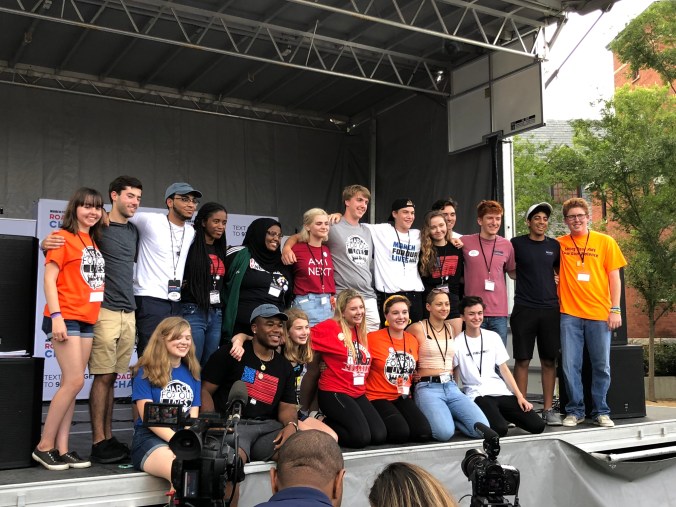
Photo by Amanda M. (Owner of Within and Without Blog)
*Quick civics lesson on rights and liberties: these two terms are not interchangeable.
Rights are freedoms granted by the government to the people; therefore, the government retains the authority to expand or limit them. The Second Amendment exists as a right and is housed in the Bill of Rights; thus, it is a right.
Liberties are freedoms the government cannot expand or limit; they are innate and exist to assist the people in restraining the government.
 within and without